Establishing Quest: Break the Supply Lines
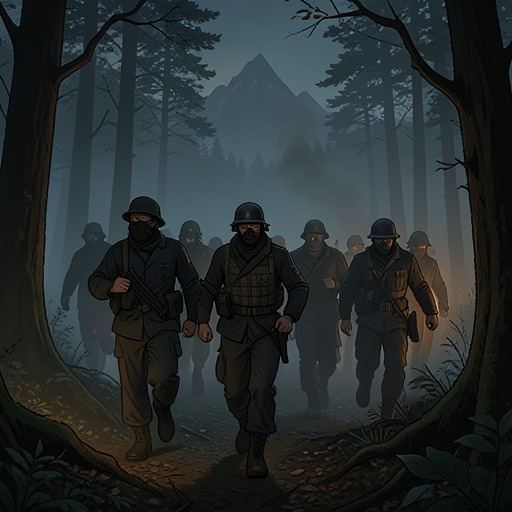
The Legend of William OhEstablishing Quest: Break the Supply Lines is the first structured mission to give Will a place within the Tower’s organized climbing economy. Its apparent simplicity—a beginner-friendly assignment to sever Kaith supply routes—conceals a decisive threshold: Will must accept a System-generated obligation, enter a dangerous cave network, work under supervision, and rely on companions whose abilities transform the terrain itself.
Causes and Background
Quest Received! announces the assignment after Will has survived the Class Creation Room, a featureless white chamber with three Altars and no exit. That earlier ordeal leaves the quest’s doorway charged with more than administrative convenience: accepting the mission means willingly approaching the same kind of threshold that had previously imprisoned him. The doorway opens only after Will leaves Leon’s General Store, since Leon refuses to risk an interdimensional entrance damaging his floor or returning Will bloodied inside the shop.
The System identifies the Kaith as having pushed into the First Floor and placed them under an extermination order issued for higher-level Climbers. Their primary nest is already under siege, but supplies continue to reach the fighting force through unknown channels. The quest therefore targets the hidden infrastructure sustaining the invasion rather than the most visible enemy concentration. Its objective is to find those channels and sever them so that the main Climber force can drive the Kaith back toward the Second Floor.
Assignment and Stakes
Leon explains that Establishing Quests are generally easy missions given to newcomers, but offer disproportionately large rewards when completed. They also function as social machinery: because many participants are young Climbers without Parties, the assignments create opportunities to find teammates. The quest thus operates simultaneously as military intervention, tutorial, and recruitment structure.
Will has fourteen minutes to decide whether to accept. The time limit is not the duration of the mission but the period in which he must choose whether to enter it at all. After he answers yes outside the shop, the doorway appears before him, identical to the portal associated with the white room that had nearly killed him. The contrast between the mission’s advertised accessibility and the memory of two days trapped without food or water makes acceptance a calculated act of courage rather than casual compliance.
Course of the Expedition
Nathan becomes the group’s appointed supervisor, describing himself as the newcomers’ babysitter and immediately organizing them into a rough line. He emphasizes the distinction between the actual objective and the obvious danger: a large hole nearby leads into an extensive cave system used by the Kaith to move food toward front-line battles with higher-level Climbers, but the participants are not there to seek a direct fight with Kaith warriors. Climbers who intend to advance a civilian Class are asked to step forward, and roughly a dozen do so, revealing the group’s mixed purposes and uneven combat ambitions.
The expedition divides into seven groups to scout the branching caverns. The tunnels plunge into darkness and force the search parties to separate quickly. In theory, Kaith warriors should be concentrated at the front, where stronger Climbers are engaging them; the workers encountered in the supply network are more consistent with the First Floor’s expected dangers. The mission’s central problem is therefore one of reconnaissance and route control: the group must understand a maze while avoiding an enemy concentration it is not equipped to fight directly.
Loth’s insects become an essential logistical tool. A bucket-sized barrel of soil topped with food scraps contains dozens of insect species, all of which Loth controls with ease. At every branch, he leaves an arrow pointing back toward the route they came from, marking it with the luminous juices of crushed glowbugs. The insects and their improvised container are not decorative curiosities; they provide tracking, navigation, and environmental control in a space where darkness can erase the party’s progress.
The physical environment repeatedly converts exploration into a survival test. During one crossing, Will lands hard on a ledge after a fall and briefly risks tumbling into the emptiness below. Loth throws him a rope and instructs him to hold it against the wall, extending the group’s reach across the gap. The moment captures the quest’s governing method: progress depends less on overwhelming strength than on shared equipment, rapid assistance, and the ability to turn a hostile cave into a traversable route.
Consequences and Significance
The quest establishes a model of advancement based on cooperation rather than solitary improvisation. Will’s earlier survival depended on enduring confinement, spending scarce money, and using whatever opportunity appeared. This mission places him inside a chain of command, a temporary Party structure, and a strategic objective whose success depends on information and supply denial. Its “beginner” status does not make the environment safe; it teaches that the Tower distributes danger through rules, terrain, time limits, and resource networks.
The event also enlarges the meaning of conflict with the Kaith. The enemy is not merely a body of warriors to be defeated in combat. Their continued presence on the First Floor is made possible by food, tunnels, workers, and concealed channels. By directing newcomers toward those channels, the quest makes logistics a form of combat and turns the cave system into a contested political and military space. The mission’s decisive shift is from isolated survival to organized intervention: Will enters as someone who has barely escaped a death trap and emerges into the wider machinery that determines who can hold a floor, sustain an army, and climb higher.